GovStack Modularity and Trust Frameworks: Executive Summary

Updated: May 25
GovStack’s modular “building block” approach is directionally correct. Governments do not need another generation of bespoke e‑government platforms. They need reusable parts that can be adopted incrementally and swapped over time. The risk is that, in the trust layer, modularity is being treated as a software assembly problem rather than a governance and evidence problem.

GovStack defines building blocks as reusable “software code, platforms, and applications” in its primary reference materials at the ITU GovSpecs. The Wallet release notes explicitly state the Wallet Building Block avoids mapping itself to specific regulatory frameworks and claims no conformance, leaving legal alignment to implementers. The Wallet WGDR 2025‑05‑02 records the removal of a must‑level eIDAS/eIDAS2 requirement and reiterates a framework‑agnostic posture. In donor‑accelerated deployments, this predictably turns defaults into policy unless law becomes operational first.
Everything below is illustrative and not a recommendation to adopt any specific external framework. The central point is simple: without a legality gate and inspection‑ready trust services, even building blocks aligned only to the European eIDAS framework and the European Digital Identity framework in Regulation 2024/1183 will not survive real deployment scrutiny.
What GovStack modularity means today and why trust breaks it
GovStack’s official modularity language is software‑centred. The ITU GovSpecs definition treats building blocks as interoperable software that can be reused across use cases and contexts. The GovStack Implementation Playbook similarly frames building blocks as reusable software modules deployed and combined in a standardised manner.
This is a workable definition for many components. It becomes fragile in the trust domain because trust components do not merely “run workflows”; they execute legally relevant acts: issuance, revocation, consent withdrawal, verification, logging, inspection, and correction. When those acts are not explicitly governed, the platform becomes the policy surface by default. This is the failure mode described in GovStack failure and the governing discipline in Law before code
GovStack itself recognises the separation: in Intersection between Specifications and Legal Frameworks, GovStack explains why it keeps specifications technical and expects implementers to account for relevant regulation. That stance supports sovereignty and global applicability, but only if GovStack also provides a hard acceptance gate that prevents legality from becoming optional.
Vendor gravity and donor procurement turn “blocks” into solutions
GovStack’s ecosystem design makes adoption easier and also amplifies market dynamics. GovMarket explicitly positions itself as a bridge between governments and software or service providers for researching, planning, and procuring software aligned with the GovSpecs. The Building Block Software catalogue invites open-source and proprietary submissions, orders listings by submission date, and states GovStack does not endorse products.
Those tools are helpful. The governance risk appears when procurement channels purchase “building blocks” as operating products rather than as governable services. GovStack’s own procurement activities list tenders for “development, implementation, and maintenance” of key building blocks. UN procurement notices show precisely that pattern, including the ITU RFP for a Payments Building Block, the ITU RFP for a Digital Identity and Verification Building Block, and the ITU RFP for a Consent Building Block.
This dynamic is visible in vendor communications. A vendor announcement such as Nortal successfully completes the GovStack Information Mediator Building Block project for ITU or NRD Companies brings Unified Registry Platform to GovStack is not inherently problematic. It simply reveals a structural reality: once a marketplace and procurement channel exist, vendor solutions become the default implementation of “the block” unless legality, evidence, and oversight readiness are part of compliance.
Donor narratives amplify the toolkit framing. BMZ describes GovStack as a toolkit for government services. GIZ describes a GovStack‑compliant Diia‑based system as a flexible, proven solution. These are programme choices, not errors. They increase, not reduce, the need for domestic acceptance gates that prevent “modules” from bypassing national mandate allocation.
DPI, DPG, DPF, DPS: the procurement category error behind governance drift
GovStack’s community has produced useful definitions that separate Digital Public Infrastructure, building blocks, and Digital Public Goods in the DPGA DPI/DPG/BB definitions. The persistent failure mode comes from confusing assets with authority.
In procurement terms, four objects are being blended:
DPI is governed shared capability whose failure scales across society.
DPGs are reusable assets, not authority.
DPFs are public functions, meaning legally bounded acts such as issuing, revoking, inspecting, compelling correction.
DPS are digital public services as experienced at the interface.
When a platform is treated as DPI, or an API is treated as a DPF, authority drifts into configuration. The Seven Layers framing of this category separation is set out in DPI vs DPG vs DPF vs DPS. This distinction is not semantics. It is how you prevent “capability to request” becoming “permission to access” once systems interconnect.
The Seven Layer gaps that make trust optional
Applying the Seven Layer Model as an analytical matrix surfaces where GovStack trust needs tightening, without abandoning global reuse.
Legal authority is treated as optional in the wallet posture described in the Wallet release notes and reinforced by decisions such as the Wallet WGDR 2025‑05‑02.
Institutional mandate is not consistently required as a deployability gate across the trust stack, which leaves accountability implicit and often operational.
Canonical records are not a “data design choice”; they are the foundation of evidence and contestability. UNCITRAL provides the baseline logic for legal effect and evidentiary admissibility through the Model Law on Electronic Commerce and the Model Law on Electronic Signatures.
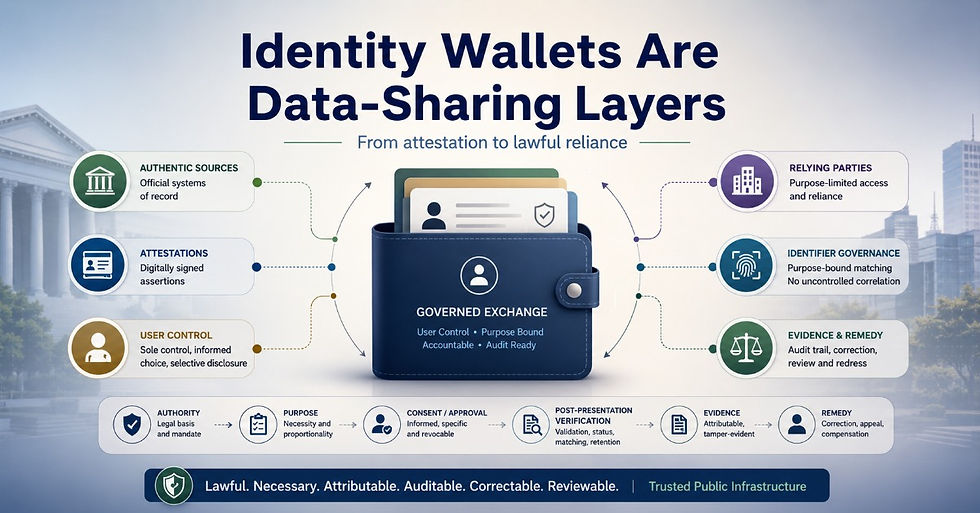
Service logic must guarantee propagation. A consent toggle is not withdrawal if the stop condition cannot propagate across relying parties and cannot be reconstructed as evidence. That is why consent withdrawal safeguards is the practical test.
Execution must be inspection‑ready. Guidance without compellable oversight yields theatre, not remedy, as argued in DPI safeguards.
Public interface is not only UX; it is where rights are exercised through receipts, status proofs, suspension triggers, and reversible outcomes.
Oversight and remedy are the point where a system either changes outcomes or merely opens tickets. Remedy must be operable across the ecosystem, not local to an app.
This is also why “alignment to eIDAS” is not enough. eIDAS defines and regulates trust services and recognition within a governance regime through Regulation 910/2014 and extends the framework through Regulation 2024/1183, but a deployment still fails if mandate, records, evidence outputs, inspection hooks, and remedy propagation are not implemented. Building blocks aligned only to eIDAS will not survive without a legality gate.
inimum modularity for trust: service contracts, evidence outputs, inspection hooks
To keep GovStack reusable and sector‑neutral, trust framework components should be specified and tested explicitly as services, not bundled systems. A modular trust service is not an API alone. It is an API plus evidence artefacts plus inspection readiness.
Below is a short evidence table that can serve as a practical baseline. These are illustrative service boundaries, not recommendations to adopt a specific architecture.
Trust service as modular unit | Required artefacts for deployability |
Authoritative event registry | Canonical record IDs, lifecycle events, correction semantics, evidentiary export aligned to UNCITRAL records logic |
Credential status and validation | Signed status proofs, time‑bound verification evidence, relying‑party receipt artefacts |
Trust lists and directories | Signed trust entries, scope of trust, revocation reasons, publication and audit access |
Time stamping and sequencing | Timestamp policy, integrity proofs, retention rules, auditable export |
Consent management | Grant and withdrawal events, controller identity, effective time, propagation trail |
Wallet as policy surface | Presentation logs, relying‑party evidence receipts, recovery and compromise events, jurisdiction profile mapping |
Signature and seal services | Signature policy, key lifecycle controls, validation artefacts, incident handling |
Data exchange disclosure control | Mandate gating, minimisation artefacts, denial logging, correction and reversal propagation |
The access control discipline that keeps disclosure and exchange defensible is described in mandate gating. The core trust scaling posture is described in Trust frameworks at scale.
Some recommendations GovStack can adopt now
I propose eight concrete and urgent moves that strengthen GovStack while building (not preserving) global reuse.
Replace “framework agnostic” with “framework pluggable, legality mandatory” for trust blocks, using deployment profiles rather than one hard‑coded regime, consistent with GovStack’s stance in Intersection between Specifications and Legal Frameworks.
Define minimum modularity in trust as service contracts that include evidence outputs and propagation semantics, rather than as system blueprints.
Add inspection readiness as a formal conformance dimension across GovSpecs, based on the enforcement posture in DPI safeguards.
Make the Friday test part of trust block readiness: withdrawal, revocation, suspension must deterministically change next‑day relying party outcomes, aligned with consent withdrawal safeguards.
Standardise mandate gating for exchange and verification across wallet, identity, and payments, grounded in mandate gating.
Align donor procurement templates to buy lawful capability, not only platforms, adopting the staged funding logic in lawful capability, and reflecting how procurement currently buys “development, implementation, and maintenance” through pages such as the GovStack procurement activities and UN calls like the Consent Building Block RFP.
Add a legality badge to GovMarket listings so “listed” does not imply “governable”, building on the catalogue structure in Building Block Software.
Publish a non‑negotiable legality gate for trust blocks that must be passed before scale, anchored in Law before code and operationalised through evidence and inspection posture.